Journal
Landscape Lighting vs Solar Lights: Which Is Right for a High-End Home in the Triangle?
By Stillight · November 18, 2026
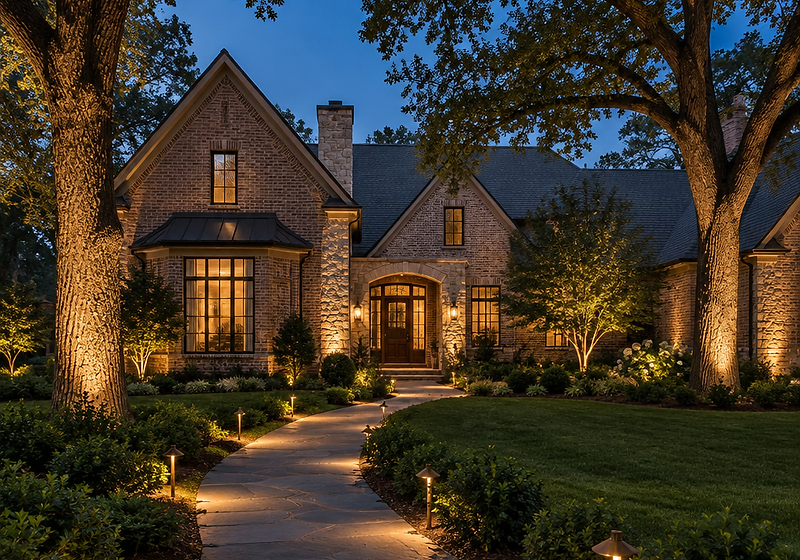
Solar costs less up front, and on the right property it is the honest buy. On a fine Triangle home under mature oaks the difference is not the brand, it is what solar can physically do after dark.
This is the question that decides whether a fine property gets a designed lighting plan or a cart full of solar fixtures, and most homeowners are comparing them on sticker price alone. It matters right now because the short December days are exactly when solar performs worst and when outdoor lighting matters most.
Every fall we walk properties where the owner has bought solar path lights and wants to know why the effect is uneven. The answer is never the brand. It is what solar can physically do after dark, and what a fine property asks of a fixture. Here is the honest comparison, including the cases where we tell a client to buy solar and skip us.
**How much less does solar cost at the start?**
Solar costs less to buy and less to install, and we say that plainly because it is true.
A basic solar setup on a mid-sized property commonly falls between a few hundred and a couple thousand dollars. There is no trenching, no transformer, no cable. You set the fixture where you want it and walk away. For a homeowner who wants a lit walkway by the weekend, nothing else competes on speed or initial outlay.
A professional low-voltage brass system runs higher, typically in the thousands and sometimes into five figures on a full property with mature canopy and multiple zones. That gap is real.
**Where does solar struggle in Triangle landscapes?**
Three things in our market work against solar, and the first is our trees.
Much of Raleigh, Cary, and Chapel Hill sits under canopy. A solar fixture under an oak gets filtered light for two hours and then none. Its panel charges less, its battery holds less, and its output falls off by nine in the evening, which is precisely when people sit outside. Bright at dusk and dim by dessert is not a solution.
The second is winter. Shorter days, lower sun angles, and gray weather stack against a panel that was already marginal in July. Late December is when outdoor lighting matters most and when solar performs worst.
The third is control. A solar fixture has fixed output, fixed beam direction, and its own color temperature. Put twelve along a drive and you will see twelve slightly different whites, and you cannot aim any of them after the stake settles. On a property where the lighting is meant to disappear into the architecture, that inconsistency is the whole failure. Output also drops within a couple of seasons from heat, dust, and cell aging, and the battery that carries the fixture overnight is a wear item.
**What advantages does a low-voltage brass system provide?**
A low-voltage system draws from one transformer, so every fixture sees the same voltage and gives the same color and output at midnight as at dusk. That consistency is the product, not brightness. Forty feet of path reads as one continuous line of light.
Brass survives our climate. Solid brass housings and sealed connections do not pit in wet clay or corrode at the joint the way thin aluminum and plastic do, and the fixtures can be re-aimed years later when a shrub grows. Integrated controls give you timers, dimming, and zones, so the terrace can be lit while the far lawn stays dark. And the light goes where you point it, which under a canopy matters more than any spec sheet figure.
**When do cheap low-voltage kits fall short?**
The big-box low-voltage kit fails for the same reason the cheap solar fixture fails: it was built to a price, not to a place.
Thin-gauge cable, plastic housings, unsealed connections, a transformer sized for the box rather than the run. In our humidity, corrosion starts at the first buried joint within two or three seasons, and parts disappear from the shelf within a few years. We remove far more of these kits than we install. The rule is simple: any fixture set in soil or mounted in a tree should be brass. The choice is not solar versus low-voltage. It is disposable versus designed, and there are disposable versions of both.
**How does maintenance add up over ten years?**
Here is where the up-front gap narrows, and usually inverts.
Solar fixtures commonly need battery replacement every few years and full replacement every three to five, because panel and cell are not serviceable separately in most consumer units. Across a decade on a property with twenty fixtures, that is two or three rounds of replacement plus the labor.
A brass low-voltage system asks for occasional cleaning, LED module service, and a transformer check once or twice a decade. The fixtures routinely stay in service fifteen to twenty-five years. Service calls happen, a mower strike or a channel that fails in a storm, and they are rare and repairable.
We do not promise that ten-year totals always favor brass. On a small property with easy access, a homeowner who replaces solar units himself may come out close. On a large property with canopy and hardscape, the arithmetic is not close.
**In what cases do we recommend solar instead?**
Regularly, and we would rather say so than sell a system that does not fit.
We recommend solar when the site has open southern exposure and little canopy, when the goal is accent and safety rather than design, when the run is a secondary path far from power, and when the client is likely to move within a few years.
We also recommend it over a cheap low-voltage kit. Between a well-made solar fixture and plastic that corrodes in two seasons, buy the solar.
What we push back on is a fine property with mature trees, a defined lighting plan, and a client who wants the fixtures invisible and the light even. Solar cannot deliver that.
**FAQ**
*Are outdoor solar lights bright enough for a driveway?*
For marking an edge, sometimes. For lighting a driveway properly, rarely. Output drops as the battery drains, and a long drive needs consistent light at ten in the evening, not just at dusk.
*Do solar panels on landscape fixtures degrade?*
Yes. Heat, dust, and cell aging reduce output over a few seasons, and the battery wears out faster than the panel. Most consumer solar fixtures are replaced, not serviced.
*Can you add solar fixtures to an existing low-voltage system?*
Not on the same circuit. They are self-powered, so they will not match the color or output of the wired fixtures and cannot be dimmed or zoned with them.
*What is the lifespan of brass landscape lighting compared to solar?*
Brass fixtures from the professional lines commonly reach fifteen to twenty-five years with serviceable parts. Consumer solar units are typically replaced every three to five years.
Consult
Tell us about the property.
A site walk, a plan, then the install. Same person throughout.