Journal
Moonlighting: Landscape Tree Lighting From Above
By Stillight · October 2, 2026
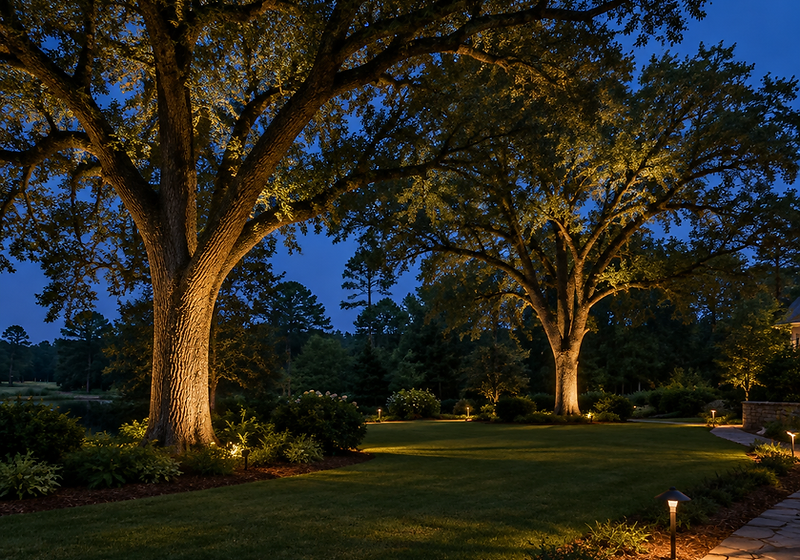
Moonlighting landscape lighting tucks one warm fixture high in a mature tree and lets the canopy filter it into soft dappled light. Where it belongs, what it costs, and why it suits oak-lined Triangle properties.
Moonlighting is landscape lighting that places a single fixture high in a mature tree — twenty to thirty feet up — aimed down through the branches so the light filters through the leaves and falls onto the ground below. Done well, it reads as moonlight, not as a light. The ground is lit, the fixture is invisible, and the canopy gains a depth it never has by day.
It belongs where you actually stand at night — a terrace, a lawn edge, a garden room you use after dinner. It does not belong on every tree. Two or three moonlights, chosen for the trees that already frame the space, will do more than a dozen uplights aimed at trunks.
The reason it works is the leaf filter. A bare bulb aimed down is a parking-lot light. The same fixture aimed through a full canopy breaks the beam into the soft dapple the moon makes on a clear night. That is why the tree has to be mature — a young maple has nothing to filter through. On a Piedmont property with established oaks — common across Raleigh, Cary, and the rest of the Research Triangle — the effect is the one guests always notice and never place.
Moonlighting tree lighting costs more than an uplight, because it requires a lift or a climber and a longer wire run. In landscape lighting design, we weigh it against the space. Where the canopy is right and the room below is used, it is the most natural-feeling light we install. Where the tree is thin or the space is unused, we leave it out.
Consult
Tell us about the property.
A site walk, a plan, then the install. Same person throughout.